|
Firearm components frequently incorporate modular mounting interfaces that allow accessories to be attached without permanent modification to the platform. One of the most widely adopted standards is the M-LOK interface, which uses a series of precisely sized slots with controlled chamfer geometry to secure accessories using T-nuts. Producing these features consistently requires tooling that can machine the slot profile and edge condition in a predictable and repeatable manner. AB Tools manufactures a dedicated solid carbide M-LOK Slot and Chamfer Cutter designed specifically for this application. The tool combines slot generation and chamfering in a single operation, allowing manufacturers to machine the interface geometry directly in the machining center without secondary finishing steps. The result is a controlled feature profile that meets the dimensional requirements of the M-LOK standard while maintaining efficient cycle times. Tool Geometry Designed for the M-LOK Interface The geometry of the cutter is built around the functional requirements of the M-LOK mounting system. Each slot must provide a flat-bottom pocket with precise length and width, along with a chamfer that allows the accessory T-nut to rotate and lock properly against the underside of the mounting surface. Deviations in slot width, corner condition, or chamfer angle can affect the clamping force and alignment of the mounted accessory. AB Tools addresses these requirements with a solid carbide cutter that integrates the slotting and chamfer features into a single tool body. The cutting edges generate the slot while simultaneously producing the required chamfer geometry along the slot edges. This approach eliminates the need to index multiple tools or perform secondary deburring operations, which reduces the potential for tolerance stack-up between machining steps. Solid carbide construction provides the rigidity required for machining aluminum receiver components, handguards, and accessory rails. The tool maintains consistent edge integrity under high spindle speeds and feed rates commonly used in firearm component production. Stable cutting conditions help maintain consistent slot dimensions across production batches. One-Tool Machining of Slot and Edge Condition Traditional machining of M-LOK interfaces may involve separate tools for slot milling and chamfering. Each tool change adds cycle time and introduces the potential for positional variation between operations. The AB Tools design allows the entire slot feature to be machined in one pass, maintaining positional accuracy between the slot floor and chamfer edges. This integrated approach simplifies CNC programming as well. The machining path generates the complete slot profile in a single toolpath sequence, allowing programmers to maintain consistent geometry across multiple slots along a handguard or mounting surface. Shops producing large quantities of firearm components benefit from reduced setup complexity and predictable machining results. The tool geometry also supports smooth chip evacuation during slotting operations. Effective chip control is important when machining long rows of slots in aluminum components, where chip recutting can affect surface finish and dimensional consistency. The cutter design promotes stable chip flow while maintaining the structural strength required for the chamfering edges. Consistency in High-Volume Firearm Manufacturing Production machining of firearm components often involves large batches of identical parts with repeated interface features. M-LOK slots are typically arranged in evenly spaced patterns across handguards, receiver extensions, and accessory mounting plates. Maintaining dimensional consistency across dozens of slots on a single part requires tooling that can maintain edge stability over long production runs. AB Tools solid carbide cutters are manufactured with tight tolerances that support repeatable slot geometry from the first part through extended production cycles. The integrated slot-and-chamfer design reduces cumulative variation because the critical interface geometry is produced in a single operation with one tool. For manufacturers producing AR-pattern components and other modular firearm platforms, this tooling approach supports reliable accessory mounting while reducing machining time per part. The result is a stable production process that balances dimensional accuracy with efficient throughput. Application Across Modular Firearm Components The M-LOK interface is used across a wide range of firearm components, including handguards, rail sections, mounting plates, and accessory adapters. Each application requires the same controlled slot geometry to ensure proper engagement of the locking hardware. Dedicated tooling simplifies production by providing a repeatable method for generating these features. AB Tools’ M-LOK Slot and Chamfer Cutter provides manufacturers with a purpose-built solution for machining this standardized interface. By combining slot milling and chamfering into one tool, the cutter supports efficient CNC machining while maintaining the dimensional precision required for secure accessory mounting.
Shops producing firearm components can integrate this tooling into existing machining programs with minimal changes while benefiting from reduced tool changes, simplified programming, and consistent feature geometry across production runs. Manufacturers producing firearm components that incorporate M-LOK mounting interfaces need tooling that can maintain consistent slot geometry while supporting efficient CNC machining. The AB Tools Solid Carbide M-LOK Slot and Chamfer Cutter provides a purpose-built solution that simplifies the machining process by generating the slot and chamfer in a single operation. If you are producing M-LOK interfaces or evaluating tooling options to improve cycle time and feature consistency, the JMI team can assist with selecting the correct cutter and implementing it in your machining process. Contact JMI CNC Tooling & Automation to discuss your application and tooling requirements.
0 Comments
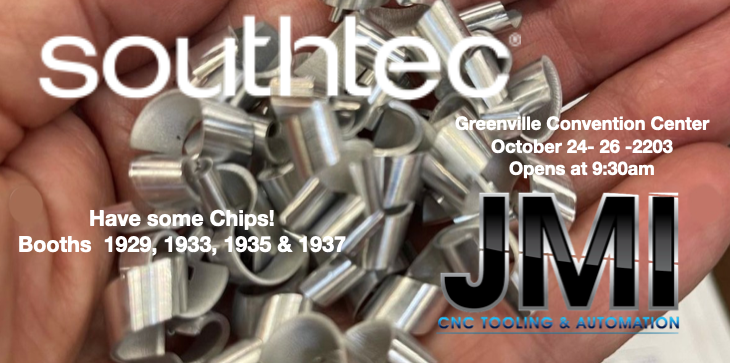
For reasons that escape most of us, SME decided to change the name of Southtec to something much longer: “The Manufacturing Technology Series SOUTHEAST.” According to SME: “The Manufacturing Technology Series unites the best of four long-standing regional manufacturing events — EAST, WEST, SOUTHEAST and SOUTHWEST — under one umbrella to ensure an unparalleled experience for both attendees and exhibitors. The Manufacturing Technology Series connects decision-makers from diverse industries with leading suppliers of advanced manufacturing technology, equipment and tooling. By creating opportunities for connection — between makers and users, thinkers and doers, and sellers and buyers — our events have a role in advancing manufacturing.” That’s the official AI generated line. But around here at Jones Marketing, we’ll still be calling it Southtec—because it’s worked for years, and frankly, it’s what everyone in the industry recognizes. Where Manufacturing Thrives — Greenville Leads the WaySouth Carolina's manufacturing sector is growing at a record pace that shows no signs of slowing, from global manufacturing headquarters to expanding advanced operations. Greenville County alone has averaged manufacturing employment growth of more than 17% over the last decade. That momentum makes Greenville the ideal hub for small and medium-sized manufacturers across the Southeast to come together, share ideas, and discover the latest technology that keeps shops competitive. Visit Jones Marketing at |
| When: October 24 - 26, 2023
| Where: Greenville Convention Center 1 Exposition Drive Greenville, South Carolina 29607 JMI Booths 1929, 1933, 1935 & 1937 |
Talk to us about!
|
|
BREAKING NEWS
Check the category list below for your subject of interest. We bring you the latest breaking news and tech tips here!
Categories
All
AB Tool
Accu-Hold
Achteck
Achteck AP100S
AKKO
Angle Heads
Arbor: Custom
Arbor: Gold Star
Arbor: Ti-Loc Swiss
Arno
Arno 3D Printed Parting
Balance Systems
BlueGrip Adhesive
Blue Photon
Boring Bars
BRISC Magnetics
BRM Brush Research
BRM - Brush Research
BRM Flexhone
B-Safe X System
Carbide Insert Height
Carbide Inserts
Carbide Insert Thickness
Carbide Insert Tolerance
Carbide Saws
CFT Coolant Fed Tooling
CNC Milling
CNC Swiss
CNC Turning
Collet Chucks
Drilling
EWS
EWS BMT65
EWS Command Tooling
EWS.Techline
EWS Tool Technologies
EWS Varia VX
Flex-Hone
George Whalley
GMN USA
Horizon Carbide
IMTS
Inserts
Jergens
Jergens 52-96
Jergens Ball Lock
Jergens Fixture Pro
Jergens Washdown Tool
Machine Tool Monitoring
MAQ
MAQ Devibe Bar
MAQ Digital Protractor
MAQ Rotational Fine Boring
Martindale Saw
Masa Microconic
Micrograd
Oldham Coupling
OMG
Picatinny Rail Cutter
Pratt Burnerd
Rotary Toolholders
Saw Arbor
SOPH Magnetics
SOUTHTEC
Spade Drills
Tapmatic
TapMatic DeBurr-Z
Tapmatic Scribewriter
Tapmatic SynchroFlex
Tapmatic TapWriter
Tapping
Tech Tips
Toolholder
Toolholder Insert Height
Troubleshooting
Turning: ID Grooving
Turning: OD Grooving
Turning: Threading
WhizAdjust
WhizCut
WhizCut PZ
WhizCut WhizFix
WhizHip
WhizTwin
Widen
Workholding
Workholding Magnetic
Archives
March 2026
February 2026
January 2026
December 2025
November 2025
October 2025
September 2025
August 2025
July 2025
June 2025
May 2025
April 2025
March 2025
February 2025
January 2025
December 2024
November 2024
October 2024
September 2024
August 2024
July 2024
June 2024
May 2024
April 2024
March 2024
February 2024
January 2024
December 2023
November 2023
October 2023
September 2023
August 2023
July 2023
June 2023
May 2023
April 2023
March 2023
February 2023
January 2023
December 2022
November 2022
October 2022
September 2022
August 2022
April 2022
January 2022
July 2021


RSS Feed