
|
Moving to five-axis machining enabled this shop to dramatically reduce setup time and increase lights-out capacity, but success relied on the right combination of workholding and automation. 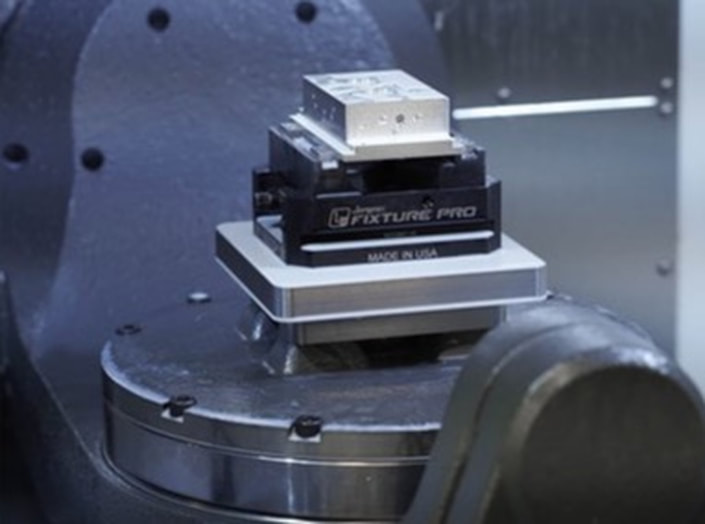 The Jergens Fixture Pro vise provides excellent clearance to maximize cutting tool access without the need for dovetails. This benefit has enabled Clippard to implement 3+2-axis machining strategies to minimize setups and produce parts lights-out. Photo Credit: Chris Kern, Jergens Five-axis machining has built its reputation in the metal manufacturing world through the many advanced machining strategies that are impossible without the additional rotational axes that set it apart. However, many manufacturers have found great benefits in 3+2-axis manufacturing techniques, using the rotational axes to reduce setup time. This approach can provide a firm foundation for highly automated machine cells such as the ones I found at Clippard Manufacturing, a Cincinnati-based valve manufacturer and machine shop. Moving to Five AxesClippard began in the 1930s as a manufacturer of radio parts. Its early claim to fame came during World War II, when it manufactured coils for the Allies’ radio-based proximity fuse — one of the most successful weapon technologies developed for the war. Over subsequent decades, the company pivoted to pneumatic valves for various industries, especially the medical industry. More recently, the company has also begun working as a contract manufacturer of medical parts, putting its experience meeting the exacting standards of the medical industry to further use. The company’s first foray into heavy automation was in its fleet of 20 Swiss-type lathes, which found success working lights-out. Using this success, Manufacturing Engineer Alex Werdman convinced the company to invest in a five-axis Haas UMC 500 SS with a 16-station pallet changer to perform work that had been done on three-axis mills. The company made this investment with the intention of developing lights-out processes for the machine cell, but getting to that point meant investing in more than just the machine tool. One of the major draws of a five-axis machine was the ability to dramatically reduce setup time by machining multiple faces of parts in a single setup. According to Werdman, the move to the five-axis Haas made the jump to high-mix medical work much easier. “Being able to reach more faces of the part reduced the setup time for secondary operations by a lot,” he says. “Jobs that took 45 minutes per part on a three-axis were down to 27 minutes.” CNC Programmer Kyle Shearer agrees, saying, “I might touch a part 17 times before and only four times now.” However, this strategy relied on workholding that provided the cutting tool as much access to the part’s faces as possible. At first, Clippard considered using dovetails, but after a conversation with Jergens representatives and distributors, the company opted for vises with modular jaws. “We thought we would have to use dovetails,” Werdman says, “but the vise has enough grip force and clearance to meet our needs.” 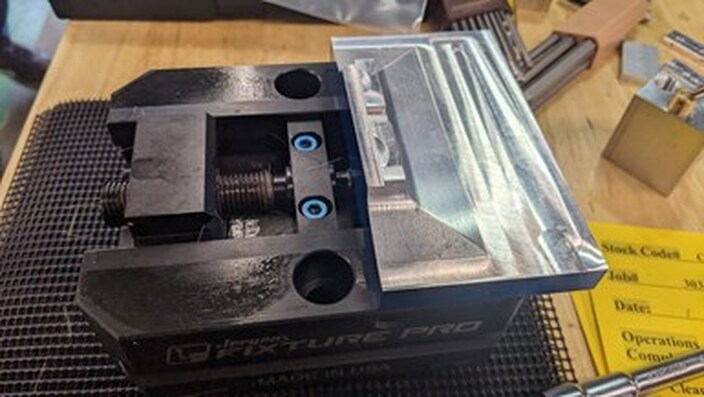 The Fixture Pro’s modularity is a major draw, as it enables the jaws to fit a wide variety of parts. In this image, the right side has a soft jaw in place, while the left side shows the wedge-shaped mount, which pulls down on the jaw as it secures it in place to increase rigidity. The Fixture Pro system is a modular vise that can provide 3,500 pounds of clamping force while the minimal profile of the jaws can dramatically improve access to the part. This provides excellent rigidity for five-axis machining, with a variety of jaw options available to meet the grip and shape requirements of the part. “There are a lot of modular jaws that work right out of the box,” Shearer says. “And if we need a specific shape, we can machine our own jaws pretty easily.” While machining jaws takes time, it is still a major time saver compared to machining a dovetail into every single part for that job. The vise is also self-centering to make it easier to consistently set up the workpiece for a job, and its jaws feature a quick-change design with no need for tightening. The jaw base connects to the top jaws using a spring system and a wedgeshaped mount. The combination of the spring and wedge pulls the top jaws down and back, firmly locking them into place and creating a highly rigid connection. As far as Werdman was concerned, the benefits of the vise were clear. “It provided three things: faster setup, better clearance, larger options,” he says. Lights-Out MillingOf course, the long-term goal of the machining cell was to machine parts lights-out. In addition to investing in reliable workholding, the company installed in-process verification systems to detect tool wear and ensure part consistency. “We still need the CMM for paperwork,” Werdman says, but ensuring the machine tool is operating at its best at all times is still necessary for unattended machining. 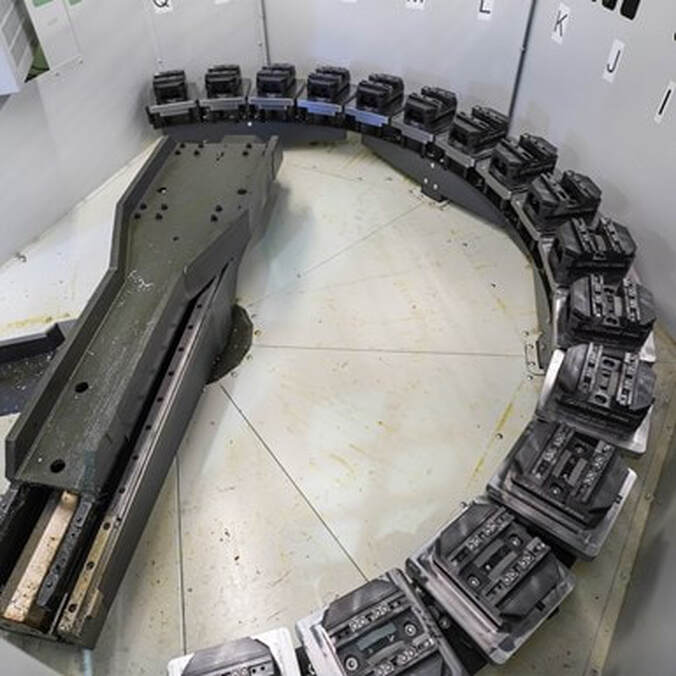 This 16-station pallet changer enables Clippard to run the five-axis UMC 500 SS unattended. The Jergens five-axis vises played a key role in designing this cell, as they enable the cutting tool to access as much of the workpiece as possible while eliminating the need for machining dovetails into every part. Photo Credit: Chris Kern, Jergens And did this work pay off? “The Haas proved that five-axis machines were worth it,” Werdman says. “We could get 50 hours a month on the three-axis mills, and with fiveaxis we get 200-300 hours.” The success of the Haas spurred Clippard to invest further in five-axis machining with a Matsuura MAM72-35V, intended to both increase the volume of parts the company could produce lights-out and improve the precision of its fiveaxis machining. The Matsuura came standard with a 32-station pallet changer in a condensed footprint, dramatically increasing the capacity for lights-out machining. Like the Haas, it regularly puts in over 200 hours of machining time, mostly performing 3+2-axis machining. It can also pursue more aggressive machining strategies while maintaining the finish needed, as it can maintain a tolerance of ±0.0005 inches. Despite being one of the major benefits of five-axis machining, this kind of dramatic increase in capacity and production speed is often overlooked by machine shops. Not all fiveaxis machines produce near-net shapes or large contours, and shops like Clippard have found great success thanks to careful consideration of the machine cell as a whole. “The people in charge needed convincing,” Shearer says, “but once they saw how much more we could get done and how quickly we could do it, they were on board.”
0 Comments
Join Jones Marketing at SOUTHTEC 2023 - October 24-26, 2023! We're a premier Manufacturers' Representative Agency will be featuring innovative metal cutting technologies from a distinctive group of high performance tooling & workholding suppliers. Some with no known competitors!  The Southeast is experiencing exceptional growth in areas critical to the economy, such as aerospace, automotive, advanced materials and workforce development – making the region a hotbed for advanced manufacturing. SOUTHTEC is designed to give manufacturers the means to discover and acquire the tools needed to drive the next evolution of their industry. SOUTHTEC creates a greater opportunity to engage first-hand with world-class suppliers and identify solutions needed – from development to final production. Save the date for SOUTHTEC 2023 - October 24-26, 2023. JMI's Booth will feature:
 And don't forget to visit our other partners while you're at the show! You can click the links below to add them to your show planner: SOUTHTEC 2023 Details
Talk to us about!
Jack Rushlander, Jergens Technical Sales Manager discusses layout and planning techniques for 5-axis machining centers. 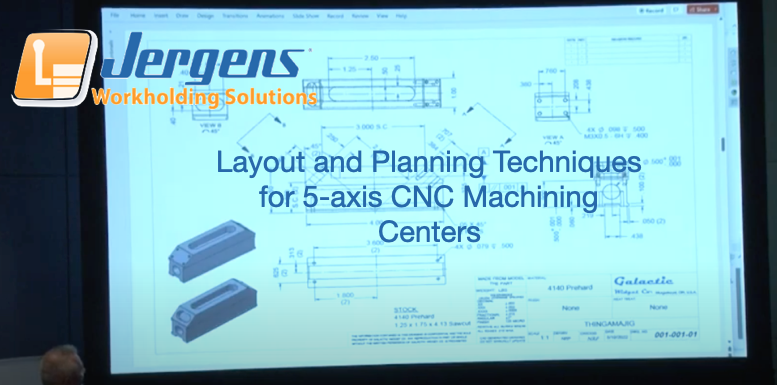 Jack Rushlander from Jergens workholding talks about how advancements in 5 Axis CNC machining technology has changed dramatically in the past 20 years. Dynamic Work Offsets and other capabilities have made workholding easier but also given shops even more opportunities to to improve process and reduce cycle time. Check out the video below and see how Galactic Widget Company tackles the workholding of a Thingamajig.
Jergens Inc. offers fixture plate machining kits and receiver bushing plugs for its line of Ball Lock quick-change mounting systems. EDITED BY JEDD COLE Production Editor, Modern Machine Shop Jergens Inc. offers fixture plate machining kits and receiver bushing plugs for its line of Ball Lock quick-change mounting systems. 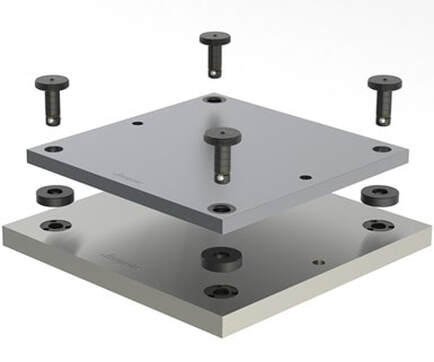 The machining kits consist of one fixture plate, four extra-long Ball Lock shanks and four spacers that provide clearance between the fixture plate and subplate below. This open space allows cutting tools to “break through” the fixture plate without damaging the subplate, making it possible to machine fixture plates while mounted to the same subplates they will be used with during production, the company says.
The plugs are designed to prevent chips and coolant from accumulating inside receiver bushings that are not in use during certain operations. This saves time by eliminating the need to clean out the bushings between setups. The receiver plugs are made of blue anodized aluminum, providing durability for better resistance to hot chips when compared to plastic plugs. The flush mount design means the plugs do not protrude above the subplate surface, making it easier to clean and avoiding interference during machining. These plugs are available in standard sizes to accommodate different hole openings and come with an O ring and tapped hole for easy installation. |
BREAKING NEWSCheck the category list below for your subject of interest. We bring you the latest breaking news and tech tips here! Categories
All
Archives
June 2024
|
 RSS Feed