JMI CNC Tooling & Automation
  • Home
  • About
  • Line Card
    • Cutting Tools >
      • AB Tools Inc
      • AKKO
      • CFT Coolant Fed Tooling
      • Horizon Carbide
      • Whizcut
    • Tooling & Workholding >
      • Blue Photon
      • Jergens
      • MAQ Devibe
      • Masa - Microconic
      • OMG Angle Heads
      • Pratt Burnerd
      • Soph Magnetics
    • Machine Accessories >
      • BRM
      • GMN USA
      • EWS
      • Tapmatic
  • News
  • Contact

Breaking news

Medical Shop Performs Lights-Out Production in Five-Axes

2/6/2024

0 Comments

 
Moving to five-axis machining enabled this shop to dramatically reduce setup time and increase lights-out capacity, but success relied on the right combination of workholding and automation.
Jergens Fixture Pro vise
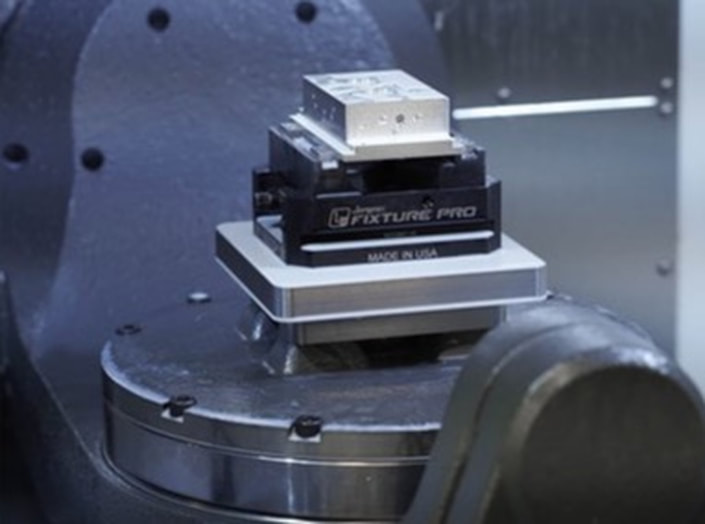
The Jergens Fixture Pro vise provides excellent clearance to maximize cutting tool access without the need for dovetails. This benefit has enabled Clippard to implement 3+2-axis machining strategies to minimize setups and produce parts lights-out. Photo Credit: Chris Kern, Jergens
Five-axis machining has built its reputation in the metal manufacturing world through the many advanced machining strategies that are impossible without the additional rotational axes that set it apart.

​However, many manufacturers have found great benefits in 3+2-axis manufacturing techniques, using the rotational axes to reduce setup time. This approach can provide a firm foundation for highly automated machine cells such as the ones I found at Clippard Manufacturing, a Cincinnati-based valve manufacturer and machine shop.
​

Moving to Five Axes

Clippard began in the 1930s as a manufacturer of radio parts. Its early claim to fame came during World War II, when it manufactured coils for the Allies’ radio-based proximity fuse — one of the most successful weapon technologies developed for the war. Over subsequent decades, the company pivoted to pneumatic valves for various industries, especially the medical industry. More recently, the company has also begun working as a contract manufacturer of medical parts, putting its experience meeting the exacting standards of the medical industry to further use.

The company’s first foray into heavy automation was in its fleet of 20 Swiss-type lathes, which found success working lights-out. Using this success, Manufacturing Engineer Alex Werdman convinced the company to invest in a five-axis Haas UMC 500 SS with a 16-station pallet changer to perform work that had been done on three-axis mills. The company made this investment with the intention of developing lights-out processes for the machine cell, but getting to that point meant investing in more than just the machine tool.

One of the major draws of a five-axis machine was the ability to dramatically reduce setup time by machining multiple faces of parts in a single setup. According to Werdman, the move to the five-axis Haas made the jump to high-mix medical work much easier. “Being able to reach more faces of the part reduced the setup time for secondary operations by a lot,” he says. “Jobs that took 45 minutes per part on a three-axis were down to 27 minutes.” CNC Programmer Kyle Shearer agrees, saying, “I might touch a part 17 times before and only four times now.” However, this strategy relied on workholding that provided the cutting tool as much access to the part’s faces as possible.

At first, Clippard considered using dovetails, but after a conversation with Jergens representatives and distributors, the company opted for vises with modular jaws. “We thought we would have to use dovetails,” Werdman says, “but the vise has enough grip force and clearance to meet our needs.”
​
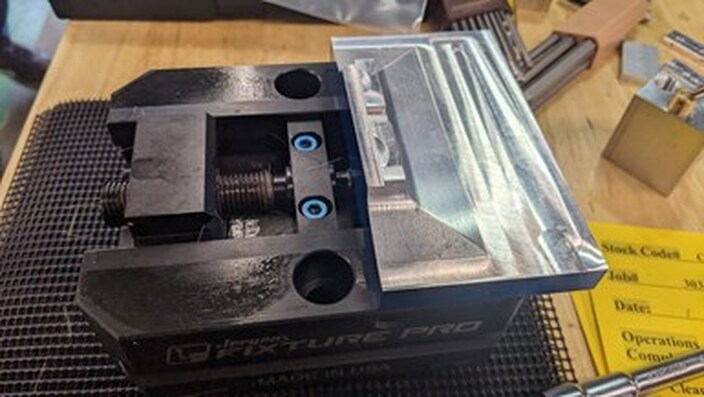
Jergens Fixture Pro workholding modularity
The Fixture Pro’s modularity is a major draw, as it enables the jaws to fit a wide variety of parts. In this image, the right side has a soft jaw in place, while the left side shows the wedge-shaped mount, which pulls down on the jaw as it secures it in place to increase rigidity.
The Fixture Pro system is a modular vise that can provide 3,500 pounds of clamping force while the minimal profile of the jaws can dramatically improve access to the part. This provides excellent rigidity for five-axis machining, with a variety of jaw options available to meet the grip and shape requirements of the part.

“There are a lot of modular jaws that work right out of the box,” Shearer says. “And if we need a specific shape, we can machine our own jaws pretty easily.” While machining jaws takes time, it is still a major time saver compared to machining a dovetail into every single part for that job.

The vise is also self-centering to make it easier to consistently set up the workpiece for a job, and its jaws feature a quick-change design with no need for tightening. The jaw base connects to the top jaws using a spring system and a wedgeshaped mount. The combination of the spring and wedge pulls the top jaws down and back, firmly locking them into place and creating a highly rigid connection.

As far as Werdman was concerned, the benefits of the vise were clear. “It provided three things: faster setup, better clearance, larger options,” he says.
​

Lights-Out Milling

Of course, the long-term goal of the machining cell was to machine parts lights-out. In addition to investing in reliable workholding, the company installed in-process verification systems to detect tool wear and ensure part consistency.

“We still need the CMM for paperwork,” Werdman says, but ensuring the machine tool is operating at its best at all times is still necessary for unattended machining.
​

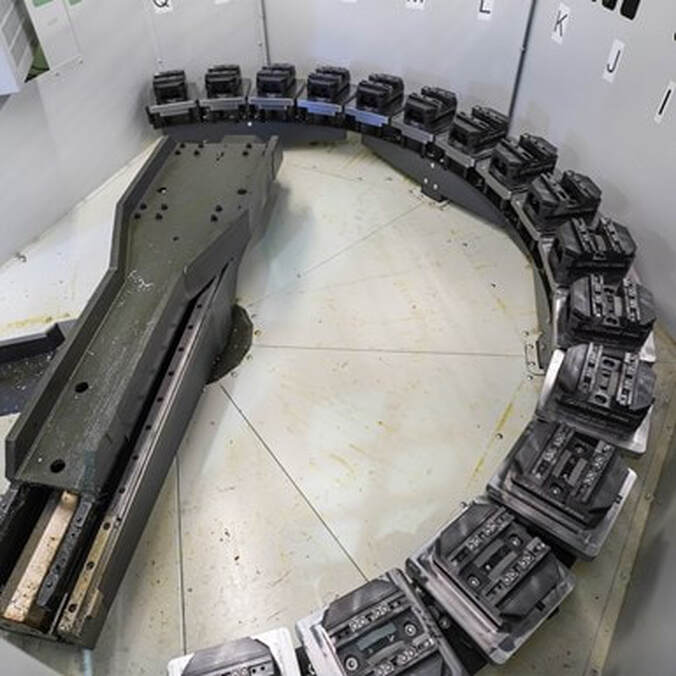
 Haas UMC 500 SS Jergens FixturePro Pallet Changer
This 16-station pallet changer enables Clippard to run the five-axis UMC 500 SS unattended. The Jergens five-axis vises played a key role in designing this cell, as they enable the cutting tool to access as much of the workpiece as possible while eliminating the need for machining dovetails into every part. Photo Credit: Chris Kern, Jergens

​And did this work pay off? “The Haas proved that five-axis machines were worth it,” Werdman says. “We could get 50 hours a month on the three-axis mills, and with fiveaxis we get 200-300 hours.”

The success of the Haas spurred Clippard to invest further in five-axis machining with a Matsuura MAM72-35V, intended to both increase the volume of parts the company could produce lights-out and improve the precision of its fiveaxis machining.

The Matsuura came standard with a 32-station pallet changer in a condensed footprint, dramatically increasing the capacity for lights-out machining. Like the Haas, it regularly puts in over 200 hours of machining time, mostly performing 3+2-axis machining. It can also pursue more aggressive machining strategies while maintaining the finish needed, as it can maintain a tolerance of ±0.0005 inches.
​
Despite being one of the major benefits of five-axis machining, this kind of dramatic increase in capacity and production speed is often overlooked by machine shops. Not all fiveaxis machines produce near-net shapes or large contours, and shops like Clippard have found great success thanks to careful consideration of the machine cell as a whole.

​“The people in charge needed convincing,” Shearer says, “but once they saw how much more we could get done and how quickly we could do it, they were on board.”
0 Comments
Masa's Mission is to be the best workholding system for Micromachining

9/13/2023

0 Comments

 
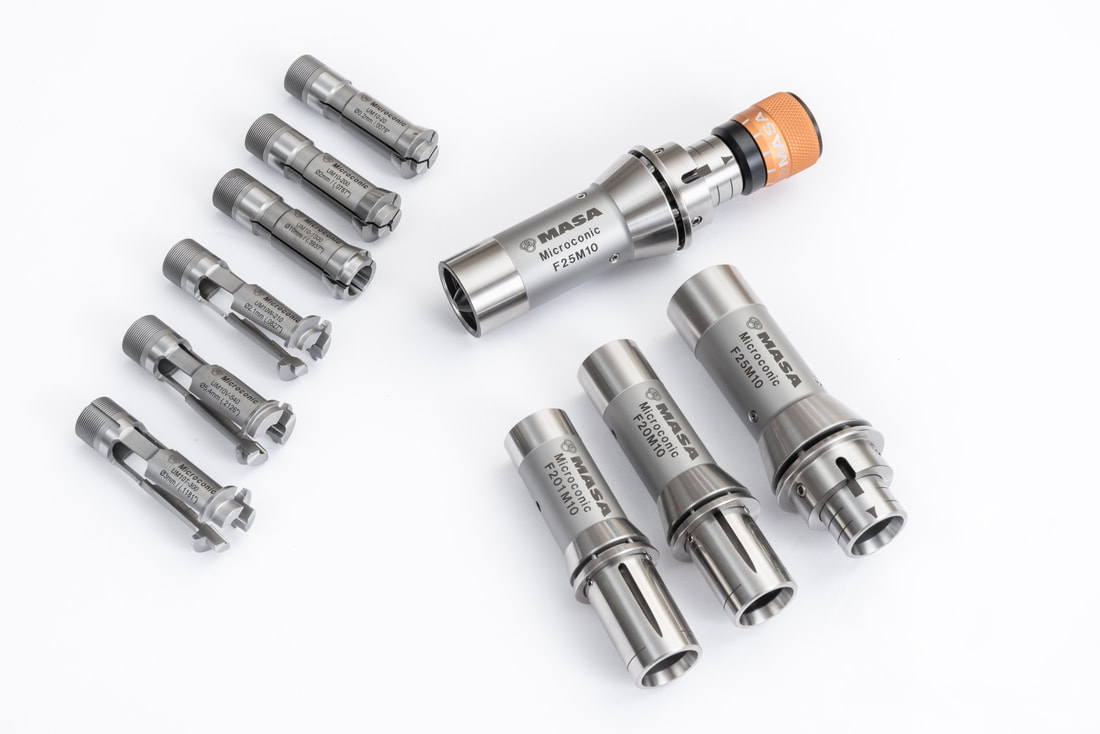
Masa Tool Microconic system 2018
Masa Tool, Inc. is a company founded with the mission of bringing micromachining solutions to industry. 

The Microconic™ work holding system is  a mechanically actuated micro-workholding system for use in high precision, small diameter CNC turning applications.

It's the first and only workholding system for the micro machining industry!
​

What is "Microconic"?

The name "Microconic" comes from the sophisticated grinding techniques that were developed for our collets. These techniques provide the advantages of extreme accuracy, high gripping force, and high tolerance for workpiece size differentials. Each finger of the collet has a separate conical surface that acts to apply the gripping force with superb accuracy.

The Microconic system is a miniaturized, precision collet system that consists of two major components: the Microconic cartridge, which fits into your machine and transforms the work spindle for miniature work holding; and the Microconic collet, a "right-sized" collet that fits in the Microconic cartridge and is designed for superior performance with small workpieces, typically .0001" to .00015" (3 microns) concentricity, and guaranteed to be within 0.0002" (5 microns) in production use.

The advantages of the Microconic cartridge

  • Simply installs like a standard collet in your machine, and is actuated like a normal collet. No modifications of the machine are necessary. Available for both draw-type collet systems (like 5c), or push-type "dead length" systems (like TF25) that are commonly used on the sub-spindle of Swiss-type CNC lathes.
  • Provides precise control of collet closure, much better than the machine's standard mechanism. Delicate parts are held firmly and precisely.
  • Designed with an extended nose that is solid and rigid, yet small in diameter so tooling and coolant have easy access to workpiece. This design eliminates the need for extended nose collets and is superior in concentricity, rigidity, and gripping force.
  • Precision ground to ultra-precise tolerances, made of the finest high-chromium tool steel. The robust design and materials ensure reliability and longevity in the most demanding production environment, while providing extreme accuracy.
0 Comments

SOPH Magnetic's BRISC Magnetic Chucks for Milling, Turning, Grinding and EDM

3/8/2023

0 Comments

 
edited by Bernard Martin
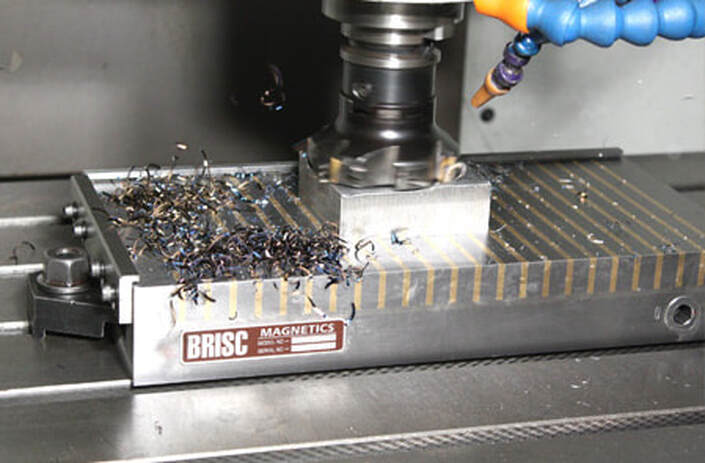
BRISC SOPH PMM Permanent magnetic chuck for milling
BRISC PMM Permanent magnetic chuck for milling
Founded in Hamburg Germany, the Soph Company have focused their efforts on developing and producing magnetic chucks under the BRISC brand name. Brisc Magnetics Co., Ltd was founded in 1998, specializing in designing and manufacturing magnetic work-holding, clamping and lifting equipments. With advanced design, outstanding performance and unsurpassed reliability they fit well in Soph's product mix

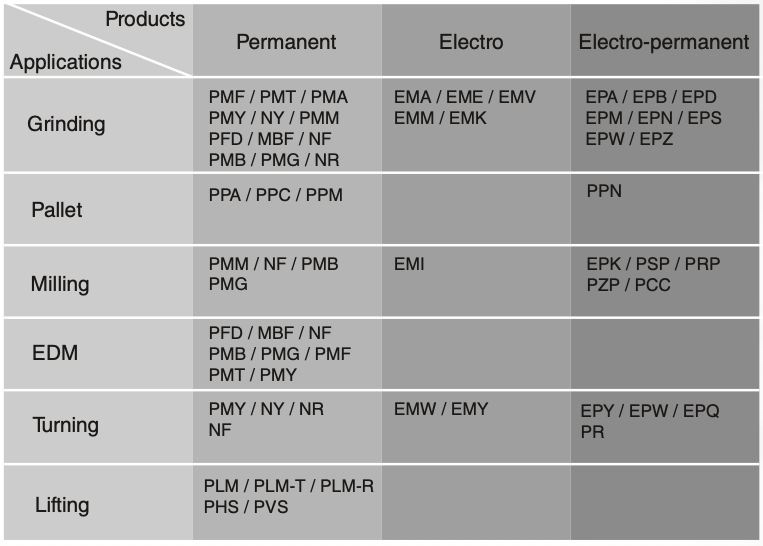
Soph's BRISC brand manufactures all kinds of magnetic chucks including permanent magnetic chucks, electromagnetic chucks and electro-permanent magnetic chucks for many work holding applications like grinding, milling, turning, EDM & WEDM.

The goal is to apply their experience and technology into the field of magnetics to provide our customers with the best magnetic solutions available in industry today.

Magnetic Workholding
​PRODUCT GUIDE

Picture
0 Comments

Layout and Planning Techniques for 5-axis CNC Machining Centers

1/10/2023

0 Comments

 
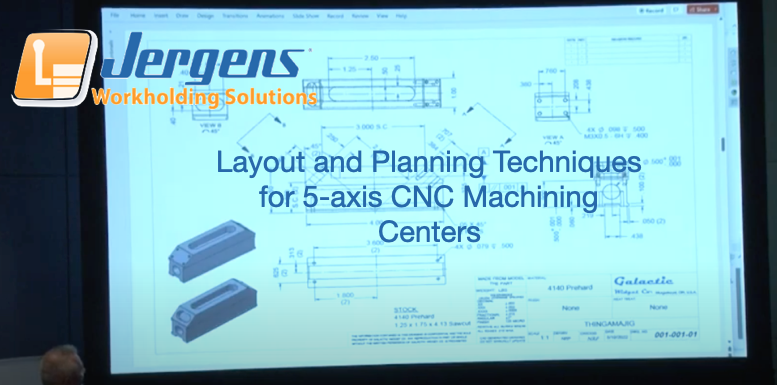
Jack Rushlander, Jergens Technical Sales Manager discusses layout and planning techniques for 5-axis machining centers.
Picture

Jack Rushlander from Jergens workholding talks about how advancements in 5 Axis CNC machining technology has changed dramatically in the past 20 years. Dynamic Work Offsets and other capabilities have made workholding easier but also given shops even more opportunities to to improve process and reduce cycle time.

5-axis machining is a game-changer in modern manufacturing, allowing for the creation of complex, precise parts with unparalleled efficiency. By enabling simultaneous movement along five axes, this technology significantly reduces the need for multiple setups, resulting in improved accuracy and faster production cycles. However, while its benefits are transformative, the challenges and considerations associated with 5-axis machining are equally significant.
​
One of the most striking advantages of 5-axis machining is its ability to streamline operations. Complex geometries that would traditionally require multiple setups can now be completed in a single run, reducing production time and minimizing the chance of errors. This capability not only enhances precision but also eliminates the need for extensive fixturing and repositioning, leading to higher-quality finishes.

Despite these advantages, adopting 5-axis machining is not without its hurdles. The machines are more complex and expensive than their 3-axis counterparts, requiring substantial investment in both equipment and training. Programming 5-axis operations is also more intricate, demanding advanced software and experienced operators who understand the nuances of tool paths and machine kinematics.

Success in 5-axis machining begins with thorough preparation. Selecting the right tools, understanding the machine's capabilities, and ensuring proper workholding are all critical. Matching the machine’s specifications—such as spindle speed, torque, and material handling capabilities—to the project requirements is equally essential.

Accurate part drawings and the right choice of raw materials lay the foundation for a successful operation. Clear, detailed drawings provide machinists with a reliable guide, while high-quality materials ensure both machining efficiency and final product performance. Tools like dovetail fixtures are particularly valuable for securing workpieces during machining, especially for intricate parts requiring multiple angles.

To maximize efficiency, leveraging tools like SolidWorks to define the machine's work envelope can help visualize part orientation and motion. This approach allows operators to identify potential collisions and optimize tool paths before production begins, saving time and resources.

Collaboration plays a crucial role in 5-axis machining. Consulting with machinists during the planning and programming phases can reveal practical insights and preempt potential issues. Troubleshooting is another vital aspect, addressing challenges such as tool deflection, chatter, and thermal expansion to maintain quality. Engaging additional perspectives—whether from colleagues or external experts—can also lead to valuable refinements in the process.

Lastly, clear and comprehensive communication with CNC programmers ensures that tool paths and machining strategies align with the project's goals. Providing detailed specifications, including geometry, materials, and tooling requirements, is essential for effective programming.

In conclusion, while this article covers key points about 5-axis machining, there’s so much more to learn about the process and its practical applications. For a detailed exploration of this technology, watch the full video below and see how Galactic Widget Company tackles the workholding of a Thingamajig and discover insights that can take your machining expertise to the next level.

  • 00:00 - 01:35 Introduction
  • 01:35 - 03:50 The Pros of 5-Axis
  • 03:50 - 06:20 The Cons of 5-Axis
  • 06:30 - 09:36 Process Essentials
  • 09:39 - 11:53 The Machine
  • 11:55 - 15:40 Part Drawing & Raw Material
  • 15:50 - 19:45 When to Use a Dovetail
  • 19:46 - 21:35 Start to Finish Operation in Drawings
  • 21:36 - 30:38 Work Envelope in Solidworks
  • 31:24 - 33:58 Analyze With Your Machinists
  • 35:30 - 37:08 Troubleshooting
  • 37:18 - 37:56 Getting Other Eyes on Your Project
  • 38:00 - 39:40 The Process of Sending Project to Your Programmer
  • 39:45 - 49:36 Questions
0 Comments

Turning to an Adhesive for Lathe Workholding

7/14/2021

0 Comments

 
Blue Photon's “Adhesive cured by ultraviolet light is an option for securing parts for machining that could otherwise distort when traditional, mechanical clamping techniques are used.”
by DEREK KORN | Editor-in-Chief, Production Machining Magazine
Blue Photon Adhesive fixturing lathe applicatio
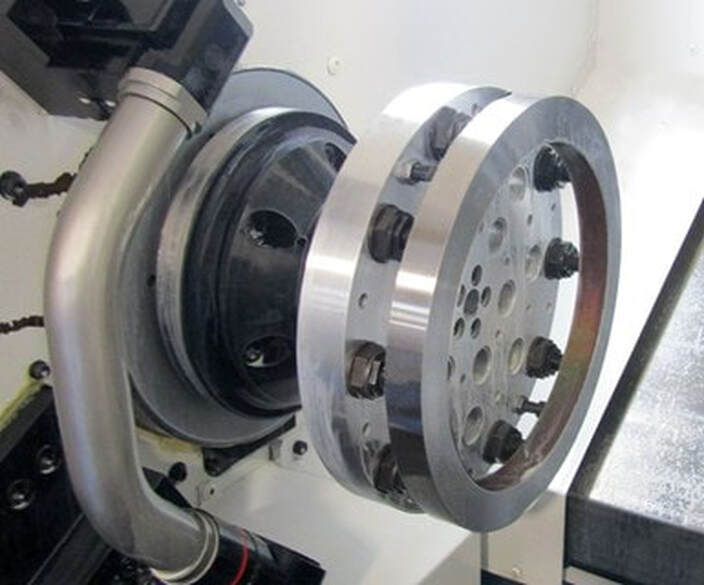
Thin rings such as this one are candidates for a photo-activated adhesive workholding process. The process eliminates part distortion that can might happen when conventional, mechanical clamping devices are used
For some turning applications, chuck jaws or other conventional workholding devices for CNC lathes can cause a part to distort as clamping force is applied. This can be the case for large, thin rings such as the one shown on the left. Those workholding elements can also prevent full access to a part, which might necessitate reclamping for an additional operation.
​
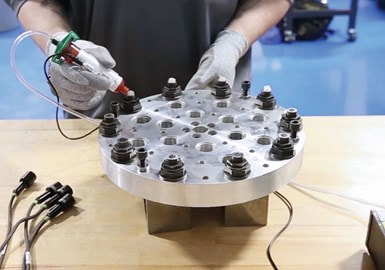
Blue Photon After cleaning grippers with isopropyl alcohol, adhesive is deposited on each onAfter cleaning grippers with isopropyl alcohol, adhesive is deposited on each on
Blue Photon offers an alternate workholding method for these types of situations that uses adhesive cured by ultraviolet (UV) light to secure a part for turning. It can also be used for other processes such as milling, grinding, electrical discharge machining and 3D printing/additive manufacturing.

​The primary components for the company’s photoactivated adhesive system are a UV light source with a light guide, BlueGrip adhesive and UV light-transmitting grippers that serve as lenses through which the UV light passes to cure the adhesive and bond a part to a fixturing element.

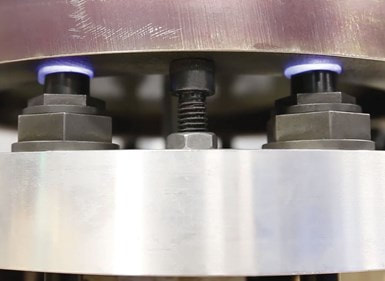
Blue Photon Workholding Grippers hard StopsHard stops, such as Allen bolts are used to provide the proper adhesive gap between grippers and part.
The threaded grippers install in the top of a fixture plate and require a through-hole to enable the UV light to pass up and through the gripper to cure the adhesive. For most turning applications, this would be done at a workstation and the fixture plate with bonded part would then be installed on the lathe.
​
To do this, the top of each gripper and the areas of the part to be gripped are cleaned with isopropyl alcohol. Adhesive is deposited on the top of each gripper so that the entire gripper face is covered and the gap between the face and underside of the part is filled. The gaps (thus, the thickness of the adhesive) can range from 0.020 to 0.120 inch, depending on part flatness. The part rests on hard stops installed in the fixture plate that are slightly taller than the gripper tops to achieve the proper gap.
​

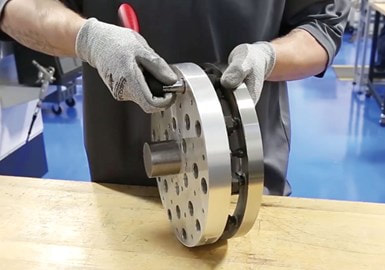
Blue Photon With the fixture removed from the machine, a wrench is used to back off each gripper and break the bond with the part.With the fixture removed from the machine, a wrench is used to back off each gripper and break the bond with the part.
To cure the adhesive, the UV light source’s light guide is inserted into the backside of each gripper and the source is activated. It typically takes 60 to 90 seconds for the UV light to cure the adhesive, bonding the gripper to the part. Once curing is complete for all grippers, the fixturing element with the part can be installed in the machine and machining can be performed.

Once machining is completed, a wrench is used to back off each threaded gripper, shearing the adhesive bond with the part. The residual adhesive can then be peeled off the part and grippers after applying steam, or a hot water soak or spray.

​The number of required grippers is based on the size of the part and its geometry, the company says. Axial holding force depends on gripper size and can range from 250 to 800 pounds. Grippers are made from hardened, corrosion-resistant stainless steel and have a black oxide finish. The adhesive is compatible with most water- and oil-based coolants and cutting fluids. It is said to be able to hold a variety of ferrous and nonferrous metals as well as plastics, ceramics and composite materials.

0 Comments

    BREAKING NEWS

    Check the category list below for your subject of interest.  We bring you the latest breaking news and tech tips here!

    Categories

    All
    AB Tool
    Accu-Hold
    Achteck
    Achteck AP100S
    AKKO
    Angle Heads
    Arbor: Custom
    Arbor: Gold Star
    Arbor: Ti-Loc Swiss
    Balance Systems
    BlueGrip Adhesive
    Blue Photon
    BRISC Magnetics
    BRM Brush Research
    BRM - Brush Research
    BRM Flexhone
    B-Safe X System
    Carbide Insert Height
    Carbide Inserts
    Carbide Insert Thickness
    Carbide Insert Tolerance
    Carbide Saws
    CFT Coolant Fed Tooling
    CNC Milling
    CNC Swiss
    CNC Turning
    Drilling
    EWS
    EWS BMT65
    EWS.Techline
    EWS Tool Technologies
    EWS Varia VX
    Flex-Hone
    George Whalley
    GMN USA
    Horizon Carbide
    IMTS
    Inserts
    Jergens
    Jergens 52-96
    Jergens Ball Lock
    Jergens Fixture Pro
    Jergens Washdown Tool
    Machine Tool Monitoring
    MAQ
    MAQ Devibe Bar
    MAQ Digital Protractor
    MAQ Rotational Fine Boring
    Martindale Saw
    Masa Microconic
    Micrograd
    Oldham Coupling
    OMG
    Picatinny Rail Cutter
    Pratt Burnerd
    Saw Arbor
    SOPH Magnetics
    SOUTHTEC
    Spade Drills
    Tapmatic
    TapMatic DeBurr-Z
    Tapmatic Scribewriter
    Tapmatic SynchroFlex
    Tapmatic TapWriter
    Tapping
    Tech Tips
    Toolholder Insert Height
    Troubleshooting
    Turning: ID Grooving
    Turning: OD Grooving
    Turning: Threading
    WhizCut
    WhizCut PZ
    WhizHip
    WhizTwin
    Widen
    Workholding
    Workholding Magnetic

    Archives

    August 2025
    July 2025
    June 2025
    May 2025
    April 2025
    March 2025
    February 2025
    January 2025
    December 2024
    November 2024
    October 2024
    September 2024
    August 2024
    July 2024
    June 2024
    May 2024
    April 2024
    March 2024
    February 2024
    January 2024
    December 2023
    November 2023
    October 2023
    September 2023
    August 2023
    July 2023
    June 2023
    May 2023
    April 2023
    March 2023
    February 2023
    January 2023
    December 2022
    November 2022
    October 2022
    September 2022
    August 2022
    April 2022
    January 2022
    July 2021

    RSS Feed

COMPANY

HOME 
​

ABOUT

INFO

LINE CARD
​

NEWS
CONTACT
©2025 Jones Marketing & JMI CNC Tooling & Automation 
ALL RIGHTS RESERVED. Created by Rapid Production Marketing

  • Home
  • About
  • Line Card
    • Cutting Tools >
      • AB Tools Inc
      • AKKO
      • CFT Coolant Fed Tooling
      • Horizon Carbide
      • Whizcut
    • Tooling & Workholding >
      • Blue Photon
      • Jergens
      • MAQ Devibe
      • Masa - Microconic
      • OMG Angle Heads
      • Pratt Burnerd
      • Soph Magnetics
    • Machine Accessories >
      • BRM
      • GMN USA
      • EWS
      • Tapmatic
  • News
  • Contact