
|
ARNO’s 3D-printed modular parting blades replace cross-drilled coolant passages with continuous internal channels that deliver higher coolant volume directly to the cutting edge. The result is improved thermal control, more stable part-off operations, and increased tool life in demanding production environments. The latest modular parting blades from ARNO take a very practical problem on the shop floor and solve it with additive manufacturing rather than incremental geometry tweaks. The goal is simple – get more coolant to the cutting edge, faster and with less restriction, under real production conditions.
Traditional modular parting blades rely on cross-drilled coolant holes. Those passages intersect at right angles or shallow angles that disrupt flow, reduce velocity, and create pressure losses before the coolant ever reaches the insert. In difficult materials or deep part-off operations, that restriction shows up quickly as heat buildup, edge breakdown, or chip welding. By moving to 3D printing, ARNO eliminates those intersecting drill paths entirely. The internal coolant channels are formed as continuous, smooth passages that run directly from the adaptor interface to the insert pocket. There are no abrupt direction changes, no dead zones, and no compromises driven by drill accessibility. Coolant reaches the cutting edge with higher volume and more consistent pressure. A key detail is the flank coolant outlet geometry. Instead of a round port dictated by drilling, the 3D-printed blades use a triangular flank port. This shape spreads coolant across the insert edge and into the chip formation zone more effectively. The result is better heat extraction at the point of cut, improved chip evacuation, and a more stable thermal condition during the cut. These blades are offered in both ARNO-specific mounts (MSA-S) and industry-standard mounts (MSA-I), making them a drop-in upgrade rather than a system change. From the operator’s perspective, setup and programming remain the same. The difference shows up in tool life, surface finish, and process reliability. In practical terms, improved coolant delivery translates directly into more parts per edge and fewer interrupted runs. Shops running stainless steels, superalloys, or long cycle part-off operations will see the most immediate benefit, but even in carbon steels the added thermal control helps maintain edge integrity and dimensional consistency. Identification is straightforward – ARNO designates these tools with a “-3D” suffix in the part number. That small detail signals a fundamentally different internal design aimed squarely at process stability rather than marketing flash. For shops that already rely on modular parting systems, the ARNO 3D-printed blades address one of the most common limiting factors in parting and grooving operations. More coolant at the edge means lower cutting temperatures, more predictable tool wear, and fewer surprises in unattended or high-mix production environments. For more technical details, application guidance, or to evaluate whether ARNO’s 3D-printed modular parting blades are a fit for your machines and materials, contact JMI CNC Tooling & Automation. Our team can help you select the correct blade configuration and coolant strategy to improve part-off stability and tool life in your operation.
0 Comments
FOR IMMEDIATE RELEASE JMI CNC Tooling & Automation (JMI) has announced that it is now representing ARNO Precision Cutting Tools, expanding its portfolio of high-performance metalworking solutions for manufacturers across its assigned territories.
Since 1962, ARNO USA has been manufacturing and selling high-quality products for customers in the industrial tooling and machining markets. ARNO USA represents the US branch of ARNO Werkzeuge, headquartered in Germany. ARNO is recognized for its engineering-driven approach to turning, milling, grooving, and holemaking tools. The company designs and manufactures a broad range of standard and application-specific tooling solutions, with a particular focus on process reliability, repeatability, and long tool life in demanding machining environments. ARNO’s product portfolio includes indexable turning systems, grooving and parting tools, milling cutters, drilling solutions, and modular tooling systems developed for steel, stainless steel, cast iron, non-ferrous materials, and high-temperature alloys. Many of ARNO’s solutions are engineered to reduce cycle time, improve chip control, and maintain dimensional consistency across extended production runs. “ARNO fits well within JMI’s technical approach to tooling and automation,” said Kennth Jones from JMI. “Their product design philosophy aligns with how we work with customers—understanding the application first, then applying the right tool geometry, substrate, and coating to achieve stable, predictable machining results.” Through this partnership, JMI will provide local technical support, application assistance, and product access for ARNO tooling, supporting both production machining and complex problem-solving applications. JMI’s role will include on-site evaluation, tooling recommendations, and integration of ARNO solutions into broader machining and automation strategies. About JMI CNC Tooling & Automation JMI CNC Tooling & Automation provides cutting tools, workholding, automation, and technical support solutions for precision manufacturers. JMI works closely with machine shops to optimize processes, improve efficiency, and support long-term manufacturing performance through application-focused solutions. For more information about ARNO tooling solutions through JMI, contact JMI CNC Tooling & Automation WhizCut WhizFix 2.0 is a modular quick-change toolholder system designed for Swiss-type lathes that reduces tool change time while maintaining repeatable positioning, compact geometry, and cutting stability comparable to solid holders. WhizCut developed the WhizFix 2.0 system to address a familiar problem on Swiss-type lathes and compact turning platforms—tool changes that interrupt flow, consume setup time, and introduce inconsistency. WhizFix 2.0 approaches this problem with a modular quick-change holder that maintains the rigidity and accuracy expected from a solid toolholder while significantly reducing changeover time. The system is built around a compact dovetail interface that allows insert heads to be exchanged directly on the machine. Locking and unlocking requires only a short rotation, with low torque values that reduce wear on both the holder and insert head. Once locked, the insert head repeats its position consistently, eliminating the need for touch-offs after routine changes. This repeatability supports stable dimensional control across longer production runs. WhizFix 2.0 maintains a short distance between the insert tip and the holder plate, which improves cutting stability and supports finer surface finishes. The holder geometry is intentionally compact, making it well-suited for machines where tool clearance and gang spacing are critical. Despite its modular design, the system performs with the stiffness typically associated with one-piece holders.
The system is offered in a range of configurations to support common Swiss turning operations, including turning, grooving, and profiling. Insert heads can be shared across compatible holders, reducing overall tooling inventory while increasing flexibility at the machine. WhizCut's WhizFix 2.0 fits well into production environments where uptime, repeatability, and quick changeovers directly affect throughput. That's a marketing line that pretty much identifies anyone running a swiss machine shop. And in this particular case, its jsut true. WhizFix 2.0 delivers in setup efficiency without adding complexity to the process, making it a practical upgrade for every swiss machine. FOR IMMEDIATE RELEASE JMI CNC & Automation is excited to announce a new partnership with AKKO Tooling Systems, a global leader in precision-engineered CNC toolholders and cutting tools. This partnership brings AKKO’s innovative and high-quality products to JMI’s customers, enhancing machining capabilities across industries with reliable, performance-driven solutions.
Founded in 1986, AKKO Tooling Systems has grown into a renowned manufacturer, delivering exceptional rotary toolholders, turning and milling toolholders, and a comprehensive range of precision inserts. AKKO also sets itself apart with an extensive range of carbide grades tailored for different applications. While many tooling manufacturers limit themselves to a handful of carbide substrates, AKKO offers both high-performance grades and wear-resistant grades, allowing them to be more competitive and meet diverse machining needs. Their advanced solutions include:
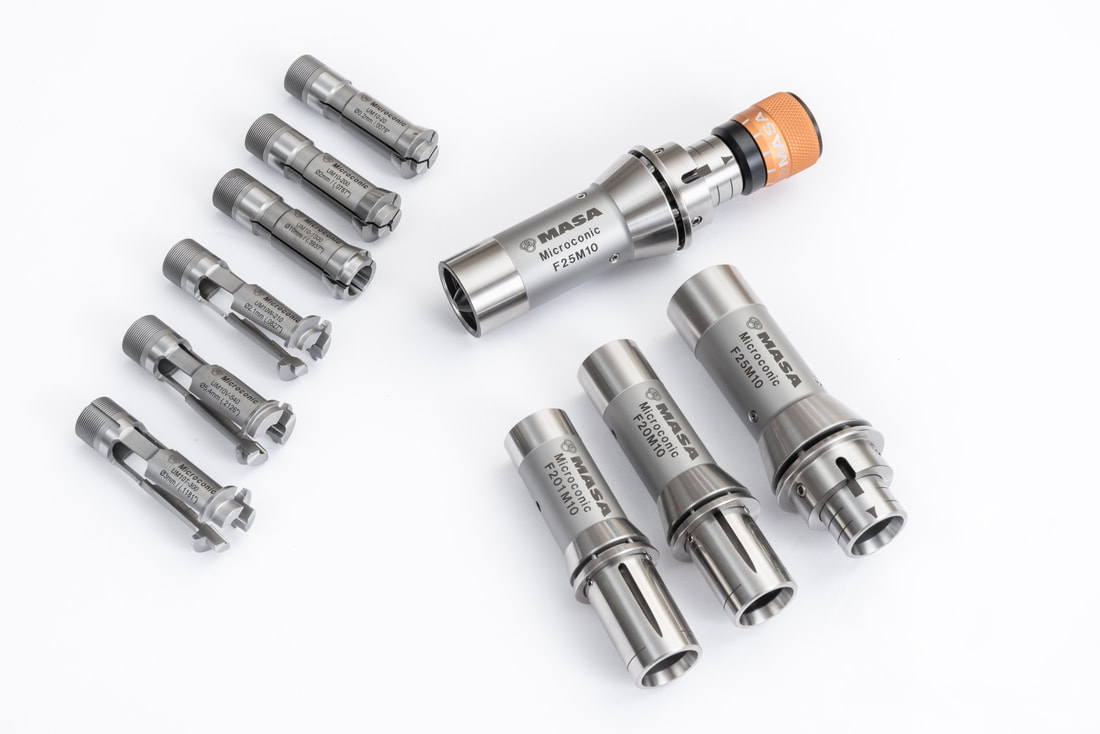
“AKKO’s ability to provide a variety of carbide grades gives our customers the flexibility to optimize performance for specific applications, whether it’s high-speed, high-precision, or wear resistance,” said Kenneth Jones, President of JMI CNC & Automation. “This unique advantage, combined with their exceptional product range, allows AKKO to stand out as a versatile and competitive solution for the modern machining industry.” continued Jones. For more information about AKKO Tooling Systems and the solutions now available through JMI CNC & Automation, visit our AKKO landing page or contact us for a on-site demonstration to test some tools! Masa Tool, Inc. is a company founded with the mission of bringing micromachining solutions to industry. The Microconic™ work holding system is a mechanically actuated micro-workholding system for use in high precision, small diameter CNC turning applications. It's the first and only workholding system for the micro machining industry! What is "Microconic"?The name "Microconic" comes from the sophisticated grinding techniques that were developed for our collets. These techniques provide the advantages of extreme accuracy, high gripping force, and high tolerance for workpiece size differentials. Each finger of the collet has a separate conical surface that acts to apply the gripping force with superb accuracy. The Microconic system is a miniaturized, precision collet system that consists of two major components: the Microconic cartridge, which fits into your machine and transforms the work spindle for miniature work holding; and the Microconic collet, a "right-sized" collet that fits in the Microconic cartridge and is designed for superior performance with small workpieces, typically .0001" to .00015" (3 microns) concentricity, and guaranteed to be within 0.0002" (5 microns) in production use. The advantages of the Microconic cartridge
|
BREAKING NEWSCheck the category list below for your subject of interest. We bring you the latest breaking news and tech tips here! Categories
All
Archives
March 2026
|

RSS Feed